Ethicist Nigel Cameron has called this the "Biotech Century," which is certainly apt, given all of the excitement over new ways to intervene into biology and medicine, even tantalizing research to change our genetic makeup and to lengthen human life.
But here's a sober bit of perspective. "Biotech" has become such a holy grail, attracting a lot of speculative investment money, without much possibility of a tangible return. Consider all of the excitement over human embryonic stem cell research, much of it driven by wishful thinking, and not necessarily a lot of good science (other blog articles on stem cell research).
Finally there comes a voice of reason. Joe Cortright is an economist and corporate VP who calls biotechnology an "idea virus." Cortright questions the mentality of going after investment money based on ideas alone, and rightly points out that biotech won't necessarily generate a lot of new jobs or create new products.
I'm reminded of the hype for "genetic engineering" in the 1990s. There were many start-up companies, and a wave of enthusiasm for these ideas. How many products resulted from the billions of dollars invested, that are actually helping people or treating disease today? Almost none. Oh, and by the way, hardly any of those companies exist anymore. The investors made a slight profit on hype alone, and got out.
The modern enthusiasm for stem cell research is leading to distortions of scientific accuracy in the public media, with the public blindly approving the use of state monies for some very questionable future gains. It's a sophisticated form of snake-oil hucksterism, where the real losers will be you and me, along with any rational understanding of human dignity.
(Article on Joe Cortright)
Showing posts with label stem cells. Show all posts
Showing posts with label stem cells. Show all posts
Wednesday, April 04, 2007


Sunday, March 25, 2007
A Pearl on Stem Cell Research

Since the bioethics news has been so serious lately, I thought we should take a break this week, and just enjoy my favorite (slightly warped) comic strip, Pearls Before Swine. This one is about stem cell research (just left click to enlarge).
I promise to return to my usual commentary next week!
I promise to return to my usual commentary next week!
Pearls Before Swine Web Site
Sunday, March 04, 2007
Stemming the Tide of Controversy
A little bit of perspective can go a long way. If one believes the media, Dr. Catherine Verfaillie is a biased scientist whose research has significant flaws. Just as we suspected all along (they seem to say), the defects in her work "prove" that adult sources of stem cells are of no value, and we must push for federal funding of destructive embryo research.
Admittedly, there were some subtle errors in Dr. Verfaillie's study that caused her to be more modest in her conclusions. Yet her basic premise, that adult stem cells (ASCs) can generate all three of the basic germ layers (from which all other body cells are derived), is still completely supported by other studies. Michael Fumento, writing in the American Spectator, put it this way:
American Spectator article
Admittedly, there were some subtle errors in Dr. Verfaillie's study that caused her to be more modest in her conclusions. Yet her basic premise, that adult stem cells (ASCs) can generate all three of the basic germ layers (from which all other body cells are derived), is still completely supported by other studies. Michael Fumento, writing in the American Spectator, put it this way:
Pointing to flaws in Verfaillie's work to say that ASCs cannot develop into all three germ layers is like declaring that new revelations on the Wright Brothers' methodology call into question whether planes actually fly or that flaws in Thomas Edison's work indicate light bulbs may not light.Dr. Verfaillie's research led to many other studies that duplicated and extended her work. Here's the actual score:
Adult Stem cells: 1300 clinical trials (over 70 approved treatments)In recent weeks, we also have seen the underreported story that human amniotic fluid may produce "embryonic-like" stem cells that can become all of the tissues of adult organs (see my commentary on this). It seems that the hype and hysteria to destroy embryos for purely speculative gains is overriding common sense.
Embryonic Stem Cells: 0 (that's right, zero: still being tested in animals)
American Spectator article
Wednesday, January 17, 2007
An Advance in Stem Cell Research
Good news from the Institute for Regenerative Medicine at Wake Forest University School of Medicine. As lead researcher Dr. Anthony Atala has just reported in the journal Nature Biotechnology, human stem cells can be found in the amniotic fluid.
Stem cells are the "starter" cells that may become various mature cells of the body. Such cells from early embryos are often called "pluripotent" cells, because each one can grow into a variety of adult tissues. Perhaps some day such cells could be used to cure a variety of human illnesses, but harvesting the cells is a real problem, since it requires the destruction of embryos, a violation of the sanctity of human life.
Now comes news that stem cells nearly as powerful as embryonic ones can be found in amniotic fluid. This is the liquid cushion that surrounds babies in the womb. Dr. Atala and his colleagues have used them to make muscle, bone, fat, blood vessels, nerves, and liver cells in the laboratory. Claims Dr. Atala: "I feel these cells are pluripotent like human embryonic stem cells."
If this research works out, and Dr. Atala cautions that any clinical applications lie several years in the future, it will make the destruction of human embryos unnecessary. Imagine, men and women of good faith, both liberals and conservatives, could agree to work together on this one, since this type of stem cell research is ethically completely acceptable.
Will this news make a difference in the divisive debate in Congress? Don’t hold your breath. Already, the House of Representatives has voted to overturn President Bush’s ban on public funding of destructive embryo research, with the Senate due to take up the measure soon.
Reuters News Report
Stem cells are the "starter" cells that may become various mature cells of the body. Such cells from early embryos are often called "pluripotent" cells, because each one can grow into a variety of adult tissues. Perhaps some day such cells could be used to cure a variety of human illnesses, but harvesting the cells is a real problem, since it requires the destruction of embryos, a violation of the sanctity of human life.
Now comes news that stem cells nearly as powerful as embryonic ones can be found in amniotic fluid. This is the liquid cushion that surrounds babies in the womb. Dr. Atala and his colleagues have used them to make muscle, bone, fat, blood vessels, nerves, and liver cells in the laboratory. Claims Dr. Atala: "I feel these cells are pluripotent like human embryonic stem cells."
If this research works out, and Dr. Atala cautions that any clinical applications lie several years in the future, it will make the destruction of human embryos unnecessary. Imagine, men and women of good faith, both liberals and conservatives, could agree to work together on this one, since this type of stem cell research is ethically completely acceptable.
Will this news make a difference in the divisive debate in Congress? Don’t hold your breath. Already, the House of Representatives has voted to overturn President Bush’s ban on public funding of destructive embryo research, with the Senate due to take up the measure soon.
Reuters News Report
Tuesday, January 02, 2007
The Year in Review
 As we enter the new year, a look back at 2006 may give us perspective. Unfortunately, this has not been a particularly good year for the notion that human beings have inherent value. In fact, human personhood as a concept took a downward turn, replaced by a disturbing 'end justifies the means' mentality. A few examples may serve to illustrate.
 The beginning of 2006 saw the public discrediting of Hwang Woo-suk, the stem-cell researcher and media darling. In 2005 he became famous as the first to clone a human embryo to produce stem cells, with their supposed promise of curing a variety of human ailments. When it turned out that Hwang had largely fabricated his results, he was fired, and he now faces a variety of criminal charges.
Yet according to Fortune Magazine, "far from discrediting the field of stem-cell research, the scandal has juiced up the race for cloning patents . . ." In California, and most recently in Missouri, stem cell research has received legal protections and large infusions of public money. Much of the excitement about embryo-destructive research is based on hype and misinformation.
In other news from 2006, the recent approval of over-the-counter sales of Plan B, the so-called "morning-after pill," ignores the real possibility that this so-called pregnancy preventative may sometimes cause an early abortion. See my earlier post on this. I have also discussed both of the above stories in recent editions of the CedarEthics Podcast.
Finally, November 8th saw oral arguments before the U.S. Supreme Court in two cases involving the federal ban on partial-birth abortion. Three lower courts have decided that the law does not pass constitutional muster. Partial-birth abortion, morally indistinguishable from outright infanticide, will be the most important issue of the new year, with a court decision due next summer (news article).
In the past year, a vague notion of human dignity was often trumped by utilitarian considerations, making it easy to sacrifice less visible human lives for the "greater good." May God help us in 2007 to reverse this trend.
Thursday, December 14, 2006
Of Babies and Body Parts
This holiday season is all about new life. But in a cruel parody of the Christmas story, grisly news has emerged from the Ukraine. According to the BBC News Service, it appears that healthy newborn babies have been slaughtered as a source of stem cells. Video evidence from actual autopsies reveals dismembered infants, and raises disturbing questions about how they died. According to the BBC:
There is real value to using bone marrow as a source of stem cells; such treatments have been used with volunteer adult donors for many years. Yet the rich clients who pay to obtain them from dead babies cannot seriously expect that some sort of "ethics" will guide the Ukrainian doctors who are complicit with murder.
If this horrible story turns out to be true (and the early evidence is very worrisome), it will be just one more indication of the hype and hysteria over "stem cell research" that promises much more than it can deliver.
BBC News Story
Ukraine has become the self-styled stem cell capital of the world. There is a trade in stem cells from aborted foetuses, amid unproven claims they can help fight many diseases.A British forensic pathologist is "very concerned to see bodies in pieces," as might be the case if stem cells were removed from the bone marrow of these infants.
But now there are claims that stem cells are also being harvested from live babies.
There is real value to using bone marrow as a source of stem cells; such treatments have been used with volunteer adult donors for many years. Yet the rich clients who pay to obtain them from dead babies cannot seriously expect that some sort of "ethics" will guide the Ukrainian doctors who are complicit with murder.
If this horrible story turns out to be true (and the early evidence is very worrisome), it will be just one more indication of the hype and hysteria over "stem cell research" that promises much more than it can deliver.
BBC News Story
Monday, October 16, 2006
A Papal Pronouncment on Ends and Means
A good result can never justify intrinsically unlawful means. That was the gist of the statement by Pope Benedict XVI on September 16, to participants in a symposium on stem cell research organized in Rome by the Pontifical Academy for Life.
Some other noteworthy excerpts:
Full text of Papal statement:
http://www.zenit.org/english/visualizza.phtml?sid=95972
Some other noteworthy excerpts:
The Pope has underlined a view of embryo research informed by a resolute committment to the sanctity of life from conception. Rather than opposing beneficial research, he simply reminds us that we need not destroy other human beings to achieve valuble clinical goals. Such goals can be obtained through adult sources of stem cells, to the furtherment of human flourishing everywhere.May I also point out, in the face of the frequently unjust accusations of insensitivity addressed to the Church, her constant support for research dedicated to the cure of diseases and to the good of humanity throughout her 2,000-year-old history.
If there has been resistance -- and if there still is -- it was and is to those forms of research that provide for the planned suppression of human beings who already exist, even if they have not yet been born. Research, in such cases, irrespective of efficacious therapeutic results is not truly at the service of humanity . . .
The human being is not a disposable object, but every single individual represents God's presence in the world.
Full text of Papal statement:
http://www.zenit.org/english/visualizza.phtml?sid=95972
Sunday, October 08, 2006
Of Bunnies and Men
Scientists are moving forward with plans to create hybrid human and rabbit embryos. This was the news three days ago from the U.K., where three teams of researchers were seeking to gain approval from the Human Fertilisation and Embryology Authority to create embryos that are 99.9 per cent human and 0.1 per cent rabbit. They are also looking into the possibility of blending genes from humans and cows to create chimeras.
A chimera (pronounced keye-MARE-ah), from Greek mythology, was “a monstrous creature made of the parts of multiple animals” (def. from Wikipedia). The thing had the head of a lion, but the body of a goat, and a snake for its tail. This fire-breathing beast had to be detroyed by the hero Bellerophon, with the help of Pegasus, the winged-horse.
In biology, the word ‘chimera’ describes an animal that can (rarely) occur naturally, with the blending of genetic material from two or more different embryos. However, science can now produce animal chimeras in the laboratory from two completely different species. For example, in 1984 a geep was produced by combining embryos from a goat and a sheep.
The U.K. proposal is really not all that new, inasmuch as rabbit/human chimeras have already been produced in China in 2003, though not allowed to divide for more than a few days. The new wrinkle is to use such hybrids as a source of stem cells for medical research. The embryos would be mostly human, but would contain some animal genes. They hope to provide a new source of stem cells “without the ethical problems of tampering with human life.”
How does that work? Scientists hope to justify destructive human embryo research by adding in a few bunny genes? Is that ethically an improvement? Does that honor human nature?
If such ideas make you uncomfortable, it’s because of the inherent “yuck factor.” We have a natural revulsion to mixing our genes with animals. Leon Kass has written that such reactions are a form of wisdom: “Repugnance is the emotional expression of deep wisdom, beyond reason’s power fully to articulate it.”
Call it instinct, intuition, or natural law, this is scary stuff.
U.K. news article: http://news.scotsman.com/topics.cfm?tid=10&id=1477452006
A chimera (pronounced keye-MARE-ah), from Greek mythology, was “a monstrous creature made of the parts of multiple animals” (def. from Wikipedia). The thing had the head of a lion, but the body of a goat, and a snake for its tail. This fire-breathing beast had to be detroyed by the hero Bellerophon, with the help of Pegasus, the winged-horse.
In biology, the word ‘chimera’ describes an animal that can (rarely) occur naturally, with the blending of genetic material from two or more different embryos. However, science can now produce animal chimeras in the laboratory from two completely different species. For example, in 1984 a geep was produced by combining embryos from a goat and a sheep.
The U.K. proposal is really not all that new, inasmuch as rabbit/human chimeras have already been produced in China in 2003, though not allowed to divide for more than a few days. The new wrinkle is to use such hybrids as a source of stem cells for medical research. The embryos would be mostly human, but would contain some animal genes. They hope to provide a new source of stem cells “without the ethical problems of tampering with human life.”
How does that work? Scientists hope to justify destructive human embryo research by adding in a few bunny genes? Is that ethically an improvement? Does that honor human nature?
If such ideas make you uncomfortable, it’s because of the inherent “yuck factor.” We have a natural revulsion to mixing our genes with animals. Leon Kass has written that such reactions are a form of wisdom: “Repugnance is the emotional expression of deep wisdom, beyond reason’s power fully to articulate it.”
Call it instinct, intuition, or natural law, this is scary stuff.
U.K. news article: http://news.scotsman.com/topics.cfm?tid=10&id=1477452006
Sunday, September 10, 2006
A New Idea in Stem Cell Research?
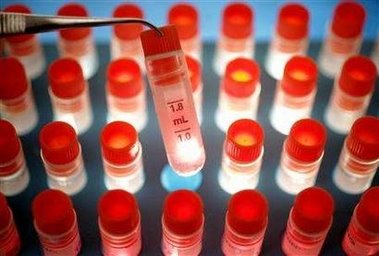 It was too good to be true. A recent report from Reuters documents a new technique that produces early stem cells, but without destroying embryos. But the devil is in the details.
As I discussed in my July 30th post, destroying embryonic humans for the supposed betterment of others violates long-held ethical standards against the taking of innocent lives. Since those who honor the sanctity of life from conception have made so much ethical fuss, scientists have been searching for other ways to produce early stem cells. Would it be possible to remove one or two cells from an embryo for this purpose, but not destroy it?
The new "breakthrough" is actually a modification of a technique that has been around for awhile. The older technique, called preimplantation genetic diagnosis (PGD), samples a single cell from an early (three-day-old) eight-cell embryo. In the past, a genetic analysis would be performed on the extracted cell to determine the fitness of the embryo for implantation into a woman's womb. Certain serious genetic diseases would result in rejection of the embryo.
The new idea is to use PGD technology to remove a single cell from a three day-old embryo to use as a starter cell for a stem cell line, leaving the embryo intact to be implanted later. Would this be an ethically acceptable way to produce embryonic stem cells?
First of all, I applaud the idea of research that attempts to avoid destroying life. Yet it is hard to imagine what good accrues to the embryonic humans involved. In other words, here is a potentially harmful procedure for which the embryos cannot give their consent, that does not benefit them in any way. This violates the principle of informed consent in research.
Furthermore, it turns out that the whole thing has been misrepresented. The research report, which appeared in the scientific journal Nature, did not accurately report the facts. Since it was a procedure performed in the laboratory, "none of the embryos was implanted and in fact several were destroyed. And no cell lines were created from single cells, but instead created by incubating several cells together." In other words, they did not accomplish what they claimed to have accomplished: an ethical way to produce embryonic stem cells.
It's bad enough when scientists want no restraints on research that many find ethically problematic, but then to distort their findings to assuage ethical criticsm seems like the height of hypocrisy. Stem cell researchers must do better.
Photo and Reuters News report from: http://news.yahoo.com/s/nm/20060906/pl_nm/science_stemcells_dc_2
Sunday, July 30, 2006
Stem Cell Stalemate

I asked my Sunday School class this morning a question. Enshrined in our religious heritage and law is the command, "Thou shalt not kill." Are there any legitimate exceptions? We came up with three: 1) wartime, 2) self-defense, and 3) capital punishment.
Of course, we could debate the nuances of each of these. For example, several religious traditions would deny there is such a thing as a "just war," while others would affirm the concept. Self defense depends on the circumstances, and even in the case of bodily attack, lethal force is not always appropriate. Capital punishment is justified in Scripture (Gen. 9:6), but in practice, there may be racial or economic inequities in the way it is administered.
On what basis do we destroy embryonic humans for the supposed betterment of others? I recognize that some do not accept the personhood of early embryos. But even among those who do (or at least who respect this idea), you may hear the argument, "Since they're going to be destroyed anyway, shouldn't we destroy the embryos so that some good may result?" This is an understandable question, but there are many flawed assumptions embedded within it.
First of all, the embryos are under the control of the families who produced them. They are now in frozen storage in fertility clinics. Their fate is not inevitable. The parents can choose to donate them to other childless couples. Such "embryo adoption" would give these embryonic humans a chance to live a full life.
Second, what is this "good" that may result? There are no currently usable medical therapies that utilize embryonic stem cells. On the other hand, there are 72 actual medical treatments utilizing adult stem cell sources. These are ethically non-problematic, and are saving lives right now. By the way, appealing to "good" in this way implies that the only "good" that human beings can have is for the parts they supply others. Don't go there.
We began this discussion by asking what circumstances might justify an exception to society's rigid rules against killing. Which of these exceptions applies to embyros? This is not war, this is not self-defense, and we certainly can't claim that embryos have committed a capital offense. Indeed, embryos are the most innocent members of our society.
Subscribe to:
Posts (Atom)

 Subscribe in a Reader


